Skip to content

 Recombinant Albumin as a Defined Excipient 

 Used in approved biologics, vaccines, and cell therapies to improve consistency and reduce formulation risk. 

Trusted by Leading Companies

Why Excipient Choice Matters in Biologic Formulations

Excipients are not passive components. In biologic formulations, they directly influence stability, consistency, and overall product performance.

  • Stability is formulation-dependent
    Protein degradation, aggregation, and loss of activity are driven by excipient environment.
  • Variability starts at the excipient level
    Heterogeneity and lot-to-lot inconsistency can introduce downstream risk.
  • Process stress impacts performance
    Shear, freeze-thaw, and storage conditions can degrade biologics without proper stabilization.
  • Regulatory expectations extend beyond API
    Excipients must be well-characterized, controlled, and justified for their specific use.
First approved no background-1

Contact us

Not All Stabilizers Are Created Equal...And Neither Is All Albumin 

When formulators evaluate excipient options for biologics, the field is wider than serum-derived vs. recombinant albumin. Polysorbates, sugars, synthetic polymers, and other protein stabilizers all compete for the same spot in your formulation. Each comes with tradeoffs. 

The real competition looks like this:

Excipient Class Common Examples  Key Limitation 
Non-ionic surfactants  Polysorbate 80, Polysorbate 20  Oxidative degradation; particle formation over time 
Sugars & polyols  Sucrose, trehalose, sorbitol  Limited protective range; no binding/carrier function 
Synthetic polymers  PVP, PEG, Poloxamers  No biological mimicry; potential immunogenicity concerns 
Plasma-derived HSA  pHSA  Lot-to-lot variability; aggregate burden; caprylate interference 
 Recombinant HSA  rHSA ( Exbumin, Optibumin 25 ) None - The Gold Standard

 Where rHSA wins across the field: 

  • vs. surfactants — Albumin provides multifunctional protection (shear, oxidation, aggregation, surface adsorption) without the oxidative instability risk that degrades polysorbates over shelf life
  • vs. sugars alone — Sugars stabilize by vitrification; they don't bind, carry, or actively protect the biologic the way albumin does. Data shows rHSA + trehalose + F127 dramatically outperforms any single excipient alone
  • vs. synthetic polymers — rHSA is biocompatible by design — it is the molecule the body uses to stabilize, transport, and protect proteins in circulation
  • vs. plasma HSA — Structural homogeneity, defined Cys34 redox state, no caprylate interference, consistent lot-to-lot performance

The bottom line:

Most excipients protect your biologic from one or two stressors. Recombinant albumin addresses shear stress, freeze-thaw damage, surface adsorption, oxidative degradation, aggregation, and formulation consistency — simultaneously, and with a growing regulatory track record behind it.

Choosing rHSA isn't just upgrading your albumin source.

It's choosing a multifunctional platform excipient with no synthetic tradeoffs.

Excipient Grade Recombinant Human Serum Albumin

Exbumin® 25

Recombinant Human Serum Albumin
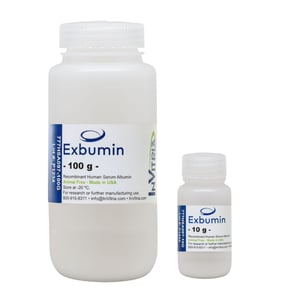
Exbumin Family replacement

Exbumin® is an excipient-grade lyophilized recombinant human serum albumin with established use in approved vaccine formulations, providing a proven regulatory foundation for injectable applications.

  • Demonstrated use as an excipient in an FDA- and EMA-approved vaccine
  • Well-characterized manufacturing and control strategy
  • Supports protein stability and protection under process stress
  • Enables streamlined regulatory positioning through established precedent

Use in: vaccine formulations, biologics, and programs leveraging existing regulatory pathways for recombinant albumin.

Optibumin® 25

Recombinant Human Serum Albumin
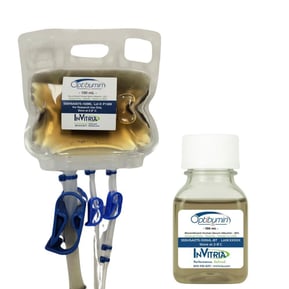
Optibumin 25 family

Optibumin® 25 is a liquid recombinant human serum albumin designed for use as a highly defined excipient in biologic formulations. It provides consistent stabilization across process and storage conditions, supporting protein integrity and performance.

  • Chemically defined, animal-origin-free
  • Low aggregate content and controlled impurity profile
  • High functional Cys34 for binding and stabilization
  • Reduced lot-to-lot variability for consistent formulation performance

Use in: formulation buffers, viral vectors, cell therapy, and biologics requiring tight control of stability and consistency.

Explore the Full InVitria Portfolio

From upstream cell culture to final formulation — discover recombinant, animal-origin-free albumin and ancillary materials designed to perform at every stage of your biologic manufacturing process. 

What We’re Talking About

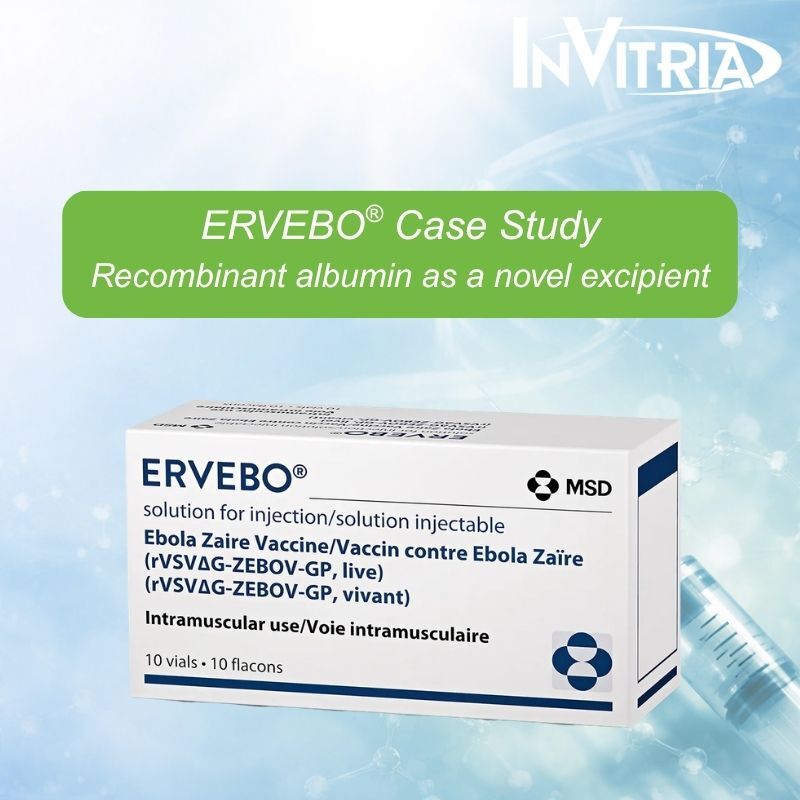
TN EVEBO Case Study

CASE STUDY: How Merck Used Recombinant Albumin in ERVEBO® to Establish a Novel Excipient Pathway

Read how Merck’s ERVEBO® program established a regulatory first for recombinant human serum albumin in an injectable vaccine, and why the lessons from that journey still matter for excipient selection, qualification, and formulation risk today.

Beyond Synthetic Surfactants hero

Beyond Synthetic Surfactants: The Case for Recombinant Human Serum Albumin (rHSA) as an Ideal Alternative to Poloxamer 188

P188 solves one problem. Recombinant albumin solves five. Explore the mechanistic differences — shear protection, ROS scavenging, metal sequestration, and more — and what they mean for your upstream and formulation performance.

Blog_Clinical_Trial_Failures_Hero

Why Do Some Biologics Cross the Finish Line—While Others Crash and Burn?

Even promising cell and gene therapies can fail—often due to overlooked CMC challenges. This quick read explores real-world case studies and offers practical steps to avoid costly late-stage setbacks, including the role of animal-origin-free materials and early CMC planning.

certificate-fda_main (1)

How Regulatory Bodies Are Driving the Shift to Animal-Origin-Free Solutions in Cell Therapy and Vaccine Development

Global regulators are moving away from animal-derived components in CGT manufacturing. Learn why animal-origin-free materials are becoming the new standard—and how they support safer, more consistent therapies.

Img_Hero_Blog_Discgenics_Stem_Cell_Therapy_10102024-scaled

Scaling Innovation: How DiscGenics and InVitria are Leading the Future of Cell Therapy

See how DiscGenics scaled from manual methods to cGMP-ready manufacturing with InVitria’s animal-free solutions—proving what’s possible when innovation meets process control.​

Why we stand out

AoF & Chemically Defined Solutions

InVitria offers high-quality, animal-free recombinant proteins and supplements that ensure consistency and safety in cell culture and biologics manufacturing. Our chemically defined solutions eliminate the variability and ethical concerns associated with traditional animal-derived supplements.

Enhanced Performance and Reliability

Our products are designed to improve the performance and reliability of your research and manufacturing processes. By providing a consistent and controlled environment, InVitria's offerings help you achieve superior results and reproducibility in your scientific endeavors.

Simplified Regulatory Approval Process

InVitria's animal-origin-free products simplify the regulatory approval process by eliminating concerns related to animal-derived contaminants. This streamlines your path to market, saving you time and resources while ensuring compliance with stringent regulatory standards.

About InVitria

IMG_5605

Our Company

InVitria is dedicated to revolutionizing the world of cell culture and biologics manufacturing with our high-quality, animal-free recombinant proteins and supplements. We offer scientists and biomanufacturers innovative solutions that address the limitations of traditional supplements such as serum. Our products are reliable, chemically defined, and free from animal origins, ensuring improved consistency and performance. By simplifying the regulatory approval process, InVitria enhances safety and reliability for our clients. Our commitment to quality and innovation helps drive advancements in scientific research and biomanufacturing.